e-Rupee vs. Self-Custody: Maintaining Privacy Under India's New 2026 Banking Rules
Financial Autonomy in the Age of Central Bank Digital Currencies
25 January 2026 • 4 min read
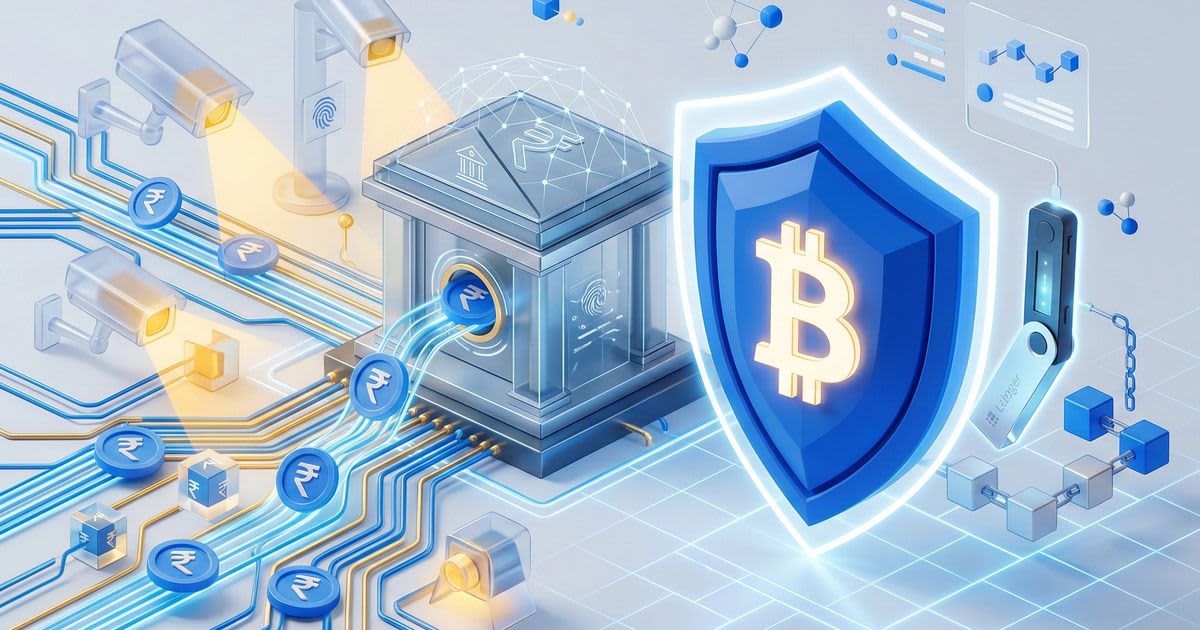
The financial horizon in India has shifted. With the full-scale implementation of the Central Bank Digital Currency (CBDC), or e-Rupee, the Reserve Bank of India (RBI) has introduced a level of programmable money never seen before. While the government touts efficiency and reduced leakages, the 2026 banking mandates have introduced stringent reporting requirements that make every digital transaction a matter of public record for regulators.
For the modern Indian investor, this isn't just about switching from paper to pixels. It is about the fundamental right to financial anonymity. As we navigate these changes, understanding the tension between state-controlled digital assets and decentralized self-custody is no longer optional; it is a necessity for anyone looking to preserve their wealth and privacy.
e-Rupee: The End of "Hidden" Cash?
Historically, physical cash provided a layer of "permissionless" privacy. You could spend it without an intermediary validating the transaction. The e-Rupee changes this dynamic by design. Since the CBDC is a direct liability of the central bank, every movement of an e-Rupee token can, in theory, be traced, logged, and even restricted based on new compliance protocols.
This level of oversight is a sharp contrast to the ethos of Bitcoin and decentralized finance. Many users are finding that the e-Rupee acts more like a "digital coupon" than "digital cash." If you are concerned about how these new rules impact your portfolio, reviewing The 2026 Indian Tax Survival Guide for HODLers is a crucial first step in understanding the broader regulatory net currently being cast over all digital assets in India.
Why Self-Custody is Your Only Privacy Shield
In an era of programmable banking, self-custody is the ultimate act of financial sovereignty. When you hold your assets in a hardware wallet like a Ledger or Trezor, you are removing the "middleman" who is legally obligated to report your every move under the 2026 rules.
Self-custody offers three distinct advantages in the current climate:
- Elimination of Third-Party Risk: Unlike the e-Rupee, which resides on a centralized ledger, your private keys stay with you. There is no bank to "freeze" your account or "limit" your spending.
- Pseudonymity: While the e-Rupee is tied directly to your Aadhaar and PAN, Bitcoin and other self-custodied assets allow for a degree of separation between your identity and your transactions.
- Future-Proofing: History shows that centralized platforms are vulnerable. Looking back From Mt. Gox to Now: A Visual History of Why Self-Custody Became Non-Negotiable reminds us that if you don't own your keys, you don't own your money.
Beyond Money: Securing Your Digital Footprint
The 2026 banking rules aren't just about currency; they are about data. The same infrastructure used to track e-Rupee transactions is often linked to broader digital identity frameworks. This makes securing your online presence just as important as securing your wallet.
You can actually use your existing hardware tools for more than just HODLing. By exploring how you can go Beyond Bitcoin: Using Your Ledger or Trezor to Secure Your Digital Identity and Emails, you can create a fortified "privacy stack" that protects your communications and exchange accounts from the same surveillance tools used in the banking sector.
The Take-Away: Choosing Your Path
The e-Rupee offers convenience and a government-backed guarantee, but it comes at the steep cost of your financial privacy. As the 2026 rules continue to evolve, the distinction between "authorized" digital assets and "sovereign" digital assets will only grow.
To maintain your privacy in 2026, you must:
- Minimize exposure to programmable CBDCs for long-term wealth.
- Embrace hardware wallets to keep your primary assets off the centralized grid.
- Stay informed on the shifting tax and reporting landscape to remain compliant without sacrificing your soul.
The transition to a digital economy is inevitable, but how much of your privacy you trade for that transition is entirely up to you.
Related posts

Industrial metal tariffs and geopolitical friction are forcing a digital asset rotation
6 April 2026 • 3 min read

The Hormuz oil shock and Federal Reserve gridlock are forcing a massive rotation in hard assets
18 March 2026 • 4 min read

India splits its digital economy between wholesale sovereign chains and retail stablecoins
11 March 2026 • 3 min read

A 9.6 trillion liquidity trap and the crypto legislation threatening to fracture global markets
2 September 2026 • 3 min read
Sovereign debt collides with the AI power squeeze as BRICS tests a parallel financial system
5 August 2026 • 3 min read

Capital flees traditional banking for private vaults and digital networks
9 September 2026 • 3 min read