The 2026 Indian Tax Survival Guide for HODLers
Navigating the 30% Tax, 1% TDS, and New Compliance Penalties
8 February 2026 • 4 min read
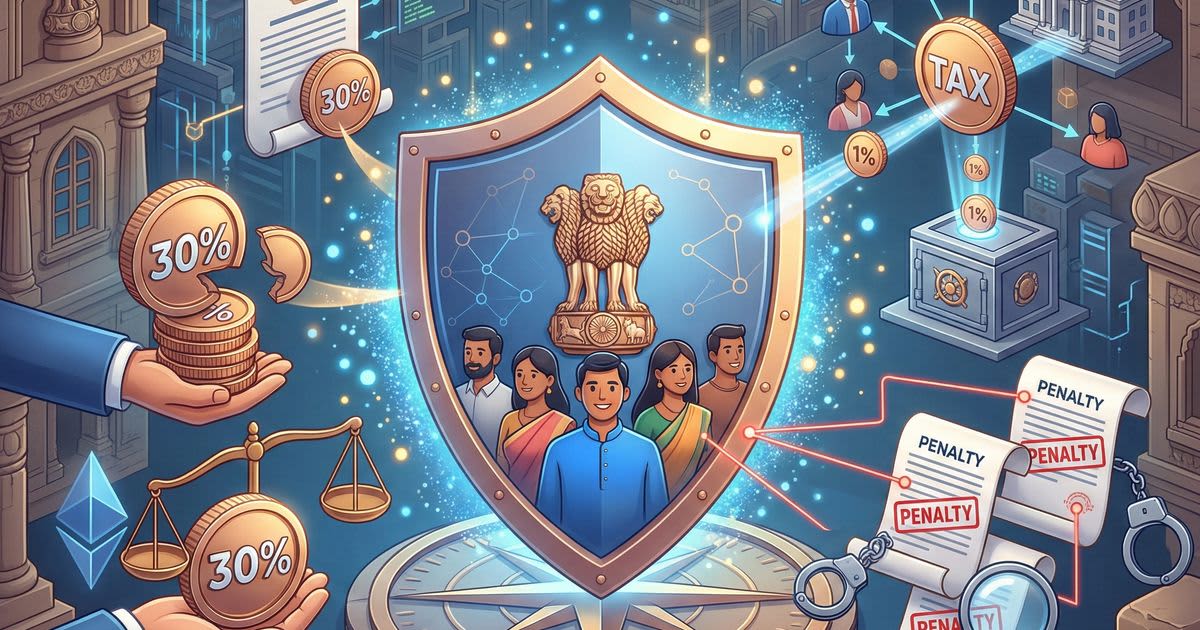
The Indian crypto landscape in 2026 is no longer a wild west. It is a highly regulated environment where every Satoshi is tracked. If you are holding Bitcoin or other digital assets, the taxman is no longer just watching from the sidelines. With the 2026-27 assessment year approaching, the rules have shifted from "let us see what happens" to "file correctly or face the consequences."
The Core Tax Reality: The 30% Flat Rule
In 2026, the foundational tax on Virtual Digital Assets (VDAs) remains the flat 30% rate under Section 115BBH. Whether you are a long term investor or a day trader, your gains are taxed at 30% plus a 4% health and education cess. There is no distinction between short term and long term capital gains.
One of the harshest parts of this regime is the lack of deductions. You cannot deduct your trading fees, gas fees, or even the electricity used if you are looking into Bitcoin Mining in India: Feasibility and Outlook for 2026. The only thing you can subtract from your sale price is the actual cost of acquisition.
The 1% TDS: The Digital Paper Trail
The 1% Tax Deducted at Source (TDS) under Section 194S is the government's primary tool for transparency. It applies to every transaction above the threshold of ₹10,000 (or ₹50,000 for specified persons). This tax is not a final tax but a tracking mechanism.
When you trade on Indian exchanges, this is handled for you. However, for P2P trades or international platforms, the burden of compliance often shifts to the user. This constant friction is why many are realizing that From Mt. Gox to Now: A Visual History of Why Self-Custody Became Non-Negotiable because keeping your assets on your own hardware wallet simplifies your long term records compared to the chaotic logs of defunct or offshore exchanges.
New for 2026: Strict Penalties and AI Enforcement
Starting April 1, 2026, the Income Tax Department has introduced a new penalty framework under Section 509.
- Non-filing Penalty: A fine of ₹200 per day for failing to submit required transaction statements.
- Inaccuracy Penalty: A flat ₹50,000 fine for providing incorrect information or failing to fix errors in your VDA reporting.
The department now uses AI-driven systems to cross-reference TDS data with your Income Tax Returns (ITR). If there is a mismatch between what the exchange reported and what you filed in Schedule VDA, a notice is almost certain.
Strategic HODLing and Heritage Planning
Since you cannot offset losses from one coin against gains from another, the "HODL" strategy has become the most tax-efficient way to handle crypto in India. By not selling, you defer the 30% tax liability indefinitely.
For many, this long term view is deeply personal. Understanding The Psychology of HODLing: Why Physical Hardware Changes Your Relationship with Money can help you stay disciplined during market volatility. As your portfolio grows, you must also think about the future. Proper Heritage Planning: How to Pass Your Bitcoin to the Next Generation ensures your heirs can inherit your digital wealth without facing a compliance nightmare.
Summary Checklist for 2026
- Report Everything: Use Schedule VDA in ITR-2 or ITR-3 to list every single disposal.
- No Loss Set-off: Remember that a loss in Ethereum cannot reduce your tax on a Bitcoin profit.
- Track TDS: Verify your 1% TDS credits in Form 26AS before filing your returns.
- Keep Records: Maintain detailed logs of acquisition dates and purchase prices in INR.
The 2026 tax regime is built on transparency. By maintaining a clean paper trail and using self-custody to manage your assets, you can navigate these stringent rules without losing your peace of mind.
Related posts
Sovereign hedges and silicon walls as institutional capital redefines the safe haven
16 April 2026 • 3 min read

The great monetary fracture as Europe digitizes fiat and BRICS hoards gold
25 March 2026 • 4 min read